Netanyahu Holds Knesset Lead in Tight Israeli Election
With 85 percent of votes counted, Netanyahu's bloc leads by five seats, forcing coalition negotiations to begin immediately.
By Benjamin Mahmoud ·

Isaac Herzog, the Israeli president, must decide who gets the first shot at forming a government. The decision hinges on the final seat count from Tuesday’s election, where turnout hit its highest level since 2001. Neither candidate holds a clear mandate, forcing a complex negotiation process to begin.
The vote resulted in a fragmented parliament of 120 seats. To rule, a candidate needs 61. As of Wednesday, 85 percent of ballots were tallied. Benjamin Netanyahu and his allies controlled 53 seats. Gadi Eisenkot, the former army chief, held 48. Two slates representing Palestinian citizens, the Joint List and Ra’am, together secured 19 seats.
Netanyahu’s path to power is constrained by a political promise. Almost all leaders vowed to exclude the Palestinian parties from any governing coalition. This creates a mathematical puzzle. Netanyahu’s bloc has 53 seats. He needs eight more to reach the majority threshold. His opponents have 48. They need 13 more if they exclude the Arab lists, or they must rely on external support from them.
The election timeline moved quickly. Exit polls released at 10 p.m. on Tuesday showed Eisenkot leading. By the following hours, the count reversed. Netanyahu’s Likud party emerged as the largest single faction with an expected 26 seats. His broader coalition gained five members over the Zionist Jewish opposition. As the sitting prime minister, Netanyahu remains in office until a new cabinet is sworn in.
Herzog is likely to task Netanyahu with forming a government first because Likud is the largest party. Netanyahu has two main options. The first involves poaching MPs from the right-wing opposition. Some of these members are settlers or former settlers who might defect. The second option is a unity deal with Eisenkot’s Yashar party and Naftali Bennett’s Together slate.
A unity government faces internal friction. It would likely require dropping at least one of Netanyahu’s far-right allies, Finance Minister Belzalel Smotrich or National Security Minister Itamar Ben Gvir. The ultra-Orthodox parties Shas and United Torah Judaism would also be at risk. The opposition campaigned on conscripting Haredi youth, a demand Netanyahu’s allies resist. Benny Gantz, another former army chief, saw his career decline after joining a similar unity deal in 2020.
Assaf David, an analyst at the Vanleer Institute, noted the strategic calculus. He said opposition parties might prefer a government without Smotrich and Ben Gvir over a second election. In a re-run, the right-wing bloc would be more organized while the opposition would fragment further. “If the final results show Netanyahu’s bloc in the lead, then some of the opposition parties might decide that it's better to have a government of Netanyahu without Smotrich and Ben Gvir than to go for a second round of elections,” David said.
Eisenkot’s path is narrower. He has nearly 70 anti-Netanyahu allies in parliament if the Palestinian parties are included. He could attempt a minority government with their outside support. However, leaders like Bennett and Lieberman have ruled out formal cooperation with Arab parties. David warned that relying on the Arab vote to tip the scale against Netanyahu is dangerous. “Netanyahu will be able to incite his supporters to use political violence, and I don't even rule out the possibility of people trying to assassinate Eisenkot,” he said.
Israel faced a similar deadlock in 2019. Two consecutive elections failed to produce a majority. The president gives a candidate 28 days to form a government. This window can extend by 14 days upon request. If no deal is struck, new polls are scheduled for a few months later. Netanyahu would remain in power until that date.
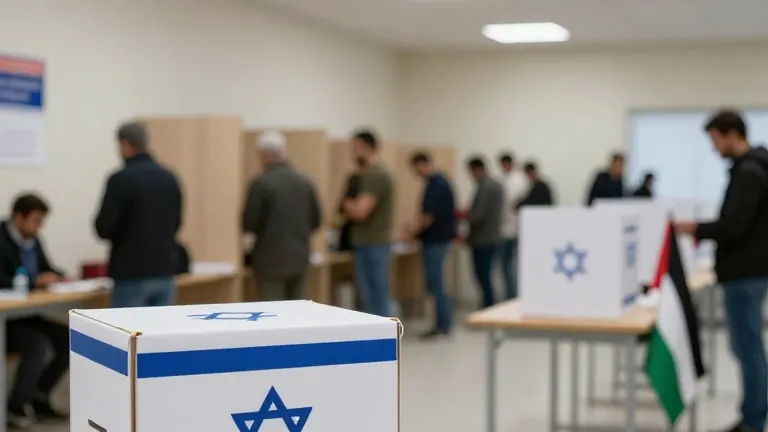
The opposition has a unique advantage that may not last. Approximately 67,000 Israelis returned from abroad to vote, mostly for Netanyahu’s opponents. Additionally, 80 percent of Palestinian citizens voted, a sharp rise from 54 percent in 2022. Many voted for the first time. David argued that this surge in participation will not repeat in a re-run. “These two facts that are in favour of the opposition bloc will not repeat themselves next time. So, I believe that everybody in the opposition bloc knows that they have to seize this opportunity and rely on the Arab vote,” he said.
Source: Middle East Eye