Palestinian citizens face critical election
Two million Israeli citizens, roughly 20% of the population, vote Tuesday as they seek leverage in coalition talks following a year of record violence.
By Benjamin Mahmoud ·
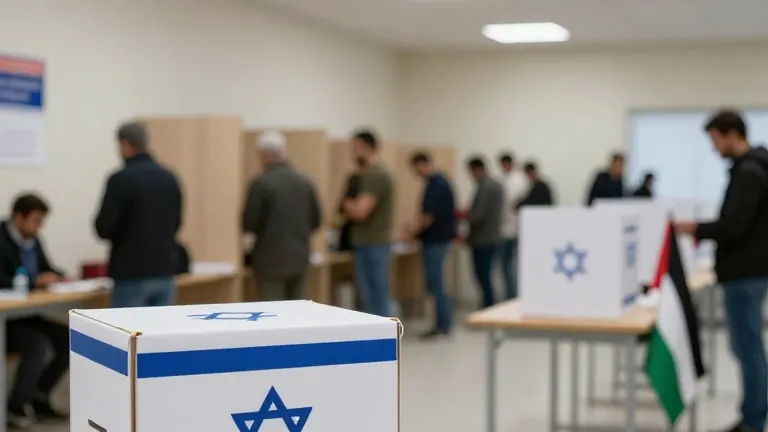
Palestinian citizens of Israel will cast ballots on Tuesday in the general election, seeking to increase their influence over the country's next government. With projections indicating the Palestinian-led alliances could secure between 18 and 20 seats in the Knesset, their votes may determine which parties form a governing coalition.
The two main electoral blocs, the Joint List and the United Arab List, have reunited or remain separate respectively ahead of this vote. The Joint List unites Hadash, Balad, and Ta'al, while Ra'am runs independently. This configuration follows the fragmentation of previous alliances and the 2021 precedent when Ra'am joined the governing coalition, helping to end Benjamin Netanyahu's twelve-year tenure as prime minister.
Political participation for this demographic has roots in the 1950s, though military rule until 1966 restricted organization. Since then, groups like the High Follow-Up Committee have coordinated efforts outside parliament. In 2015, four parties formed the Joint List to overcome a raised electoral threshold, winning 15 seats in 2020. That alliance later fractured due to internal disagreements, weakening their collective bargaining power before this year's regrouping.
The voting population numbers approximately two million people, constituting about 20% of Israel's total population of 10 million. These citizens are descendants of Palestinians who remained within Israel's borders after the 1948 war. They reside primarily in the Galilee, the central Triangle region, and the Naqab desert. Demographically, 80% identify as Muslim, 10% as Christian, and 10% as Druze.
Many identify as Palestinian citizens of Israel rather than Israeli Arabs, a term used by the state and much of society. This distinction affirms their Palestinian heritage alongside their citizenship. Their political struggle is framed by decades of discriminatory laws and state repression. Adalah, a legal center in Haifa, has identified more than 65 laws enacted since 1948 that explicitly or implicitly discriminate against Palestinians.
Key legislative measures include the 1950 Absentees' Property Law, which placed property of those who fled or were expelled during the 1948 war under state control. A 2003 law restricted family reunification with spouses from the West Bank and Gaza. In 2011, admissions committees in agricultural towns gained power to reject applicants, a mechanism critics say targets Palestinian citizens. The 2018 Basic Law declared Israel the nation-state of the Jewish people, granting self-determination exclusively to the Jewish majority and reducing Arabic to a special status.
Violence and crime have intensified in Palestinian communities in recent years. The Abraham Initiatives, an Israeli civil society organization, linked the crisis to under-policing and tense relations with law enforcement. In 2023, the group reported that 50% of violent crime affected Palestinians, despite them comprising only 20% of the population. Police cleared fewer than 15% of homicides in Palestinian communities, compared with a 65% clearance rate for victims who were Jewish.
The death toll has risen sharply. In 2022, 116 people were killed. That figure jumped to 244 in 2023. By 2025, fatalities reached 252, marking the deadliest year on record for this population. Most victims were not involved in criminal activity. Community representatives have accused police of ignoring the illegal arms trade, while the Israeli government denies responsibility for the crime surge.
Historical trauma informs current political attitudes. During the military regime, which ended in 1966, citizens faced curfews and movement restrictions. The Kafr Qasim massacre in 1956, where 49 residents were killed by soldiers enforcing a curfew, remains a defining memory. In 1976, police killed six protesters during demonstrations against land confiscation, an event commemorated annually as Land Day. More recently, during the Second Intifada, police killed 13 demonstrators and arrested hundreds in solidarity protests.
Source: Middle East Eye