Likud leads Israeli vote as Netanyahu seeks right-wing bloc
Projections show Likud winning 27 seats, but the prime minister says the result forces a government without Arab parties.
By Pablo Harrison ·
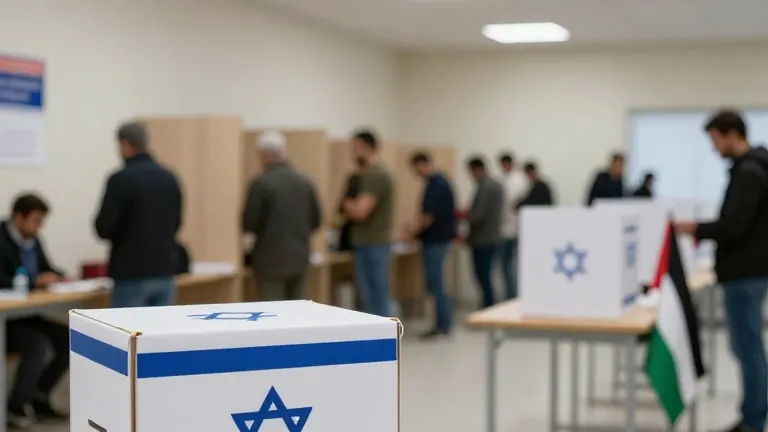
Prime Minister Benjamin Netanyahu declared that a right-wing government must form in Israel, stating on Tuesday that the country cannot rely on coalitions with Arab parties that oppose its existence. He made these remarks at Likud party headquarters in West Jerusalem shortly after polls closed for the national legislative election.
Early counts indicate a tight race between two main political blocs. With more than half of the ballots tallied, The Times of Israel projected that Netanyahu’s coalition would secure 56 seats in the Knesset. The alliance led by Gadi Eisenkot was projected to win 49 seats. Neither group currently holds a clear path to a governing majority, which requires 61 seats in the 120-member parliament.
Likud appears positioned to be the largest single party in the new legislature. Projections from Israeli Channels 12 and 13 suggest the party will win an estimated 27 seats. This figure exceeds the 21 seats projected for Eisenkot’s Yashar party. Netanyahu acknowledged this lead, noting that Likud is expected to become the largest party in Israel, though he said the final results were still one to two days away.
The prime minister used his address to list military and diplomatic achievements since assuming office in 2022. He claimed that Israel eliminated key leaders including Mohammed Deif, Ismail Haniyeh, Yahya Sinwar, Hassan Nasrallah, and Iranian Supreme Leader Ali Khamenei. Netanyahu stated that the country established security zones in Gaza, Lebanon, and Syria, and struck the Iranian regime to weaken it.
He described the current moment as a historical opportunity to work with United States President Donald Trump to remove the threat of Iran permanently. Alon Pinkas, a former Israeli ambassador and consul general in New York, observed that the party securing a majority may face an uncomfortable coalition deal. He added that opposition voters likely would not want their bloc to strike a deal with Netanyahu’s government.
Analysts noted that the prime minister attempted to project confidence despite the narrow margin of victory. Marwan Bishara, a senior political analyst, said Netanyahu was trying to show success that may not be fully justified. Bishara pointed out that while Likud is the largest party, it is reaching its lowest seat count since 2009. Dan Perry, another political analyst, said the speech was an effort to spin the situation favorably after exit polls were released.
Source: Al Jazeera