NHTSA Proposes Mandatory Cyan Lighting Standard for Autonomous Vehicles
Federal regulators have outlined a new framework for driverless cars, introducing a distinct blue-green light to indicate automated operation and simplifying legacy safety requirements.
By Aiko Yamamoto ·
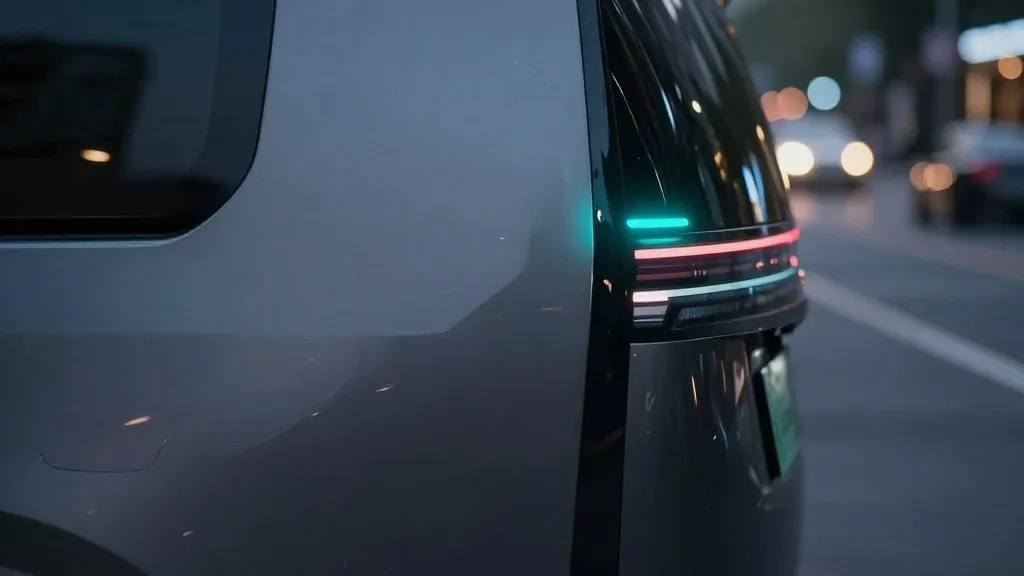
For motorists and pedestrians sharing the road with self-driving vehicles, the visual cues indicating that a car is in autonomous mode will soon have a federally defined standard. The National Highway Traffic Safety Administration (NHTSA) has released proposed revisions to Federal Motor Vehicle Safety Standard No. 108, which would establish a specific blue-green, or cyan, marker light to signal that an automated driving system is in control. This move aims to provide a consistent visual indicator for law enforcement and other road users, replacing the fragmented array of signals that have been debated in the industry for years.
The proposal seeks to fill a visual gap in current traffic lighting. Existing vehicle lights utilize red, amber, white, and flashing blue or red for functions such as braking, turn signals, and emergency identification. By designating cyan as the color for automated operation, regulators hope to create a distinct signal that does not conflict with established conventions. While the lights would be optional for manufacturers, the rule would strictly standardize their color, brightness, and placement to ensure uniformity across different brands and models.
This standardization is intended to benefit major players in the autonomous vehicle sector, including operators like Waymo, Nuro, and Zoox, as well as traditional automakers such as GM and Mercedes-Benz. There is already some precedent for this approach; Mercedes-Benz previously received state-level approval for turquoise lights on its Level 3 Drive Pilot vehicles, although the company later shifted its strategy toward a Level 2++ system. The federal proposal aims to create a cohesive national framework that allows these companies to adopt a single, legally compliant setup rather than a confusing mix of proprietary signals.
Beyond introducing the new lighting requirement, the NHTSA proposal includes significant updates to remove outdated regulations that do not apply to vehicles without human drivers. Current rules mandate the presence of physical hazard switches, manual beam shifters, and turn levers inside the cabin. The agency proposes eliminating these requirements, recognizing that they are often irrelevant to fully autonomous designs. This change is part of a broader effort to reduce regulatory friction for manufacturers building cars with modern LED architectures.
The agency is also reconsidering specific technical standards, such as the 12.8-volt testing protocol, to better align with contemporary engineering practices. Additionally, NHTSA is considering removing requirements that dictate the vertical positioning of high-beam lights relative to low-beam lights. These adjustments are designed to allow automakers more flexibility in their design processes while maintaining safety standards, ultimately supporting the Department of Transportation’s goal of streamlining the deployment of autonomous vehicles.
The proposed rule is a component of a wider administrative push to facilitate the integration of driverless technology into the national transportation infrastructure. By simplifying the rules for vehicles that lack traditional human controls, such as steering wheels and pedals, the government aims to lower the barriers to entry for new vehicle designs. This regulatory modernization is intended to accelerate the transition from prototype testing to broader public availability.
However, the path to full adoption remains subject to ongoing regulatory scrutiny. While the proposal seeks to ease constraints for future designs, current enforcement remains strict under existing rules. Last month, the NHTSA initiated an audit query regarding Tesla’s Cybercab, examining the technical data and certification process used by the company. The inquiry focused on the vehicle’s lack of certain features, including sideview mirrors, pedals, and a steering wheel, which are currently required under the existing Federal Motor Vehicle Safety Standards.
The introduction of the cyan light proposal marks a significant step in defining the visual language of autonomous transportation. By establishing a clear, uniform signal, the NHTSA aims to enhance situational awareness for all road users. As the rulemaking process continues, the automotive industry will look to these standards as a benchmark for how driverless vehicles communicate their operational status to the public.
Source: The Verge