New England trick-or-treaters report rise of savory and unusual Halloween treats
From canned tuna to Bibles, residents across Massachusetts and Rhode Island describe a growing trend of non-candy giveaways that challenge traditional holiday expectations.
By Pablo Harrison ·
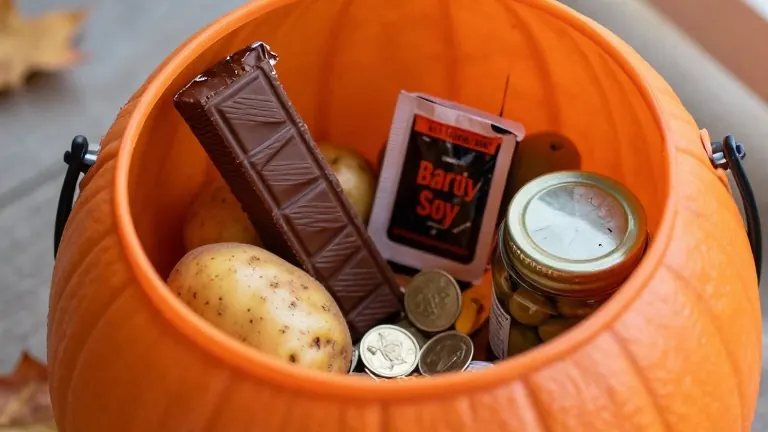
The Halloween treat has expanded far beyond the standard chocolate bar.
Residents across New England report receiving an increasing variety of savory, dry, and non-traditional items from neighbors during the holiday. A collection of anecdotes from families in Massachusetts and Rhode Island reveals a shift in what trick-or-treaters find in their bags. The items range from grocery staples to personal hygiene products, suggesting that candy is no longer the sole currency of the night.
Food items dominate the list of unusual giveaways. In Newton, one family received Brussels sprouts, while another got a Tupperware container of green tomatoes. A resident in Sudbury reported finding a russet potato in her bag. In Cambridge, a neighbor distributed small copper plumbing joints one year and stained wooden fish the next. A family in Medford recalled a time when their daughter received a jar of stuffed manzanilla olives, a treat she specifically sought out for her sister. In Acton, a household offered a choice between candy and vegetables, with the vegetable option accompanied by a dime or a quarter. One child left with a red pepper and 25 cents. In Gilmanton, New Hampshire, a man distributed juice boxes to children and Bud Light to adults, a combination that prompted parents to circle back to the house multiple times.
Non-food items also appear frequently in these reports. A family in Arlington received soy sauce packets, while neighbors in Medford handed out mayonnaise packets. In Lexington, a resident described receiving a dollar bill in a red envelope. A family in Medford got metal tongue scrapers, which the mother guessed came from a dentist's home. In Marion, a household distributed small black combs. In Beverly, a family reported receiving Bibles every year. In Peabody, walnuts were the item of choice. In West Newton, a coupon to Wendy's was given to a child. In Somerville, one family received a single adult-size ankle sock filled with hard, striped candy mints.
Some neighbors have turned these unusual giveaways into long-standing traditions. In Newton, a family began distributing ramen noodles as a pandemic experiment. The practice has continued, with children given the choice between candy and ramen. The parent noted that children often show excitement for the noodles. In Lexington, a neighbor with strong feelings about candy offers choices of natural toothpaste, soft apples, or boxes of raisins. In Arlington, a resident recalled a neighbor who distributed autographed photos of former President Richard Nixon. The neighbor was described as kind and consistent in his practice. In Quincy, a woman would toss handfuls of pennies into children's bags. In Needham, a family received individually packaged prunes, a memory that remains a source of laughter for the parents.
The variety of items suggests that many households are moving away from mass-produced candy, possibly to control portions or to add a personal touch to the holiday. Some items, like the plumbing joints and wooden fish, appear to be crafts made by the giver. Others, like the tuna and cookies, seem to be pantry staples grabbed in a moment of improvisation. In one case in Medford, a house that had not expected visitors sent out to its fruit bowl, allowing children to choose bananas. In Franklin, a family received a small canister of Play-Doh and a potato, the latter of which weighed down their pumpkin for the rest of the night. In Arlington, a child received a Thin Mint flavored tea bag and ate some of the leaves before the family realized what it was. These exchanges show that the tradition is flexible, driven by the whims of individual households rather than a unified standard.
The data points to a localized culture where neighbors use the holiday to share whatever is on hand or to make a small joke. The items are specific to the region, with a heavy concentration in the Boston suburbs. The consistency of certain items, like the Bibles in Beverly and the ramen in Newton, indicates that these are not one-time experiments but recurring practices. The reactions from families vary from amusement to mild surprise, but most report the experience as memorable. The trend reflects a preference for personal interaction over standardized distribution, even if that interaction results in a bag full of peas or a can of Coke.
Source: The Boston Globe