
Francis Halzen wins 2026 Nobel Prize for IceCube neutrino work
The University of Wisconsin-Madison physicist received the honor for discovering high-energy particles originating outside the galaxy.
By Benjamin Mahmoud ·
Francis Halzen of the University of Wisconsin-Madison received the 2026 Nobel Prize in Physics on October 6. The Nobel Prize committee cited his decisive contributions to the IceCube Neutrino Observatory. They specifically recognized his role in the discovery of high-energy neutrinos of astrophysical origin. This award marks a new milestone in the field of particle astrophysics.
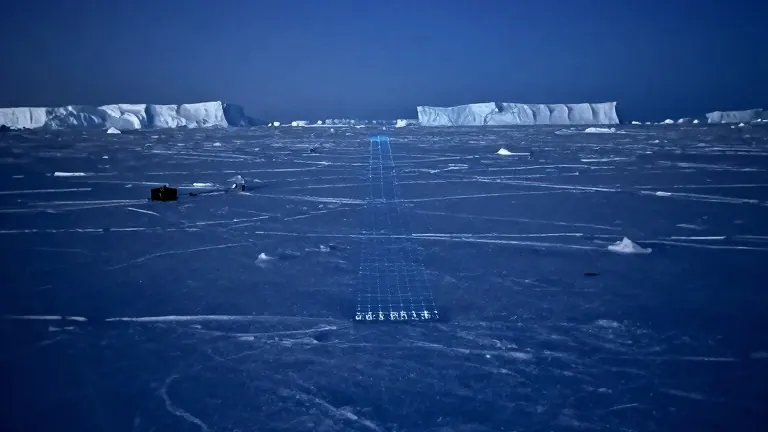
IceCube is a massive detector installed in one cubic kilometer of Antarctic ice. Its size is necessary because neutrinos interact very rarely with matter. The device is designed to detect all three known flavors of neutrinos: electron, muon, and tau. Previous detection methods were limited in their ability to observe these particles across their various states.
The technology allows scientists to track the path of incoming particles. When a neutrino interacts with the ice, it produces a brief flash of light known as a Cherenkov flash. Detectors record these flashes to reconstruct the particle's trajectory. This process enables researchers to point telescopes toward the source of the signal.
Andrew Mattson, a physics PhD student, explained the implications of this detection capability in an interview. He noted that IceCube measured neutrinos from outside the solar system and outside the galaxy. This capability opened a new field of neutrino astronomy. Scientists can now study distant objects such as black holes, supernovae, and quasars using particles that travel with less interference than photons.
Neutrinos are elementary particles that do not carry an electric charge. They are affected only by weak nuclear forces and gravity. They do not interact with the strong force or electromagnetism. This lack of interaction allows them to carry clear information from distant cosmic events. Photons, by contrast, are more likely to be scattered or absorbed during travel.
The study of neutrinos dates back to the 1930s. Physicist Wolfgang Pauli proposed the particle to explain energy discrepancies in beta decay. Beta decay occurs when an unstable atom emits an electron and a neutrino. Later analysis distinguished between beta-minus decay, which produces an antineutrino, and beta-plus decay, which produces a neutrino.
Mattson highlighted a specific hypothesis regarding neutrino properties. He suggested that a neutrino could act as its own antiparticle. If this were true, neutrinos could annihilate each other and release energy. Observing this process in radioactive isotopes could explain why the universe contains so much matter and so little antimatter.
The Nobel committee has recognized neutrino research before. In 2002, scientists received the prize for detecting cosmic neutrinos from the sun. In 2015, the award went to researchers who discovered neutrino oscillations. That discovery showed that neutrinos can switch between different flavors as they travel. Earlier experiments missed many solar neutrinos because they were only sensitive to one type.
The current prize recognizes the advancement in detection scale and sensitivity. Halzen’s work helped establish the infrastructure that made these discoveries possible. The field now has the tools to probe the nature of the universe in new ways. The next step involves the construction of IceCube Gen2, which will be eight times larger than the current facility.
Source: The Johns Hopkins News-Letter