UN Vote on Cuba: Waltz Cites $876 Million in U.S. Trade
The U.S. ambassador detailed specific trade figures and political prisoner data to argue against a new resolution on the island.
By Chloe Edwards ·
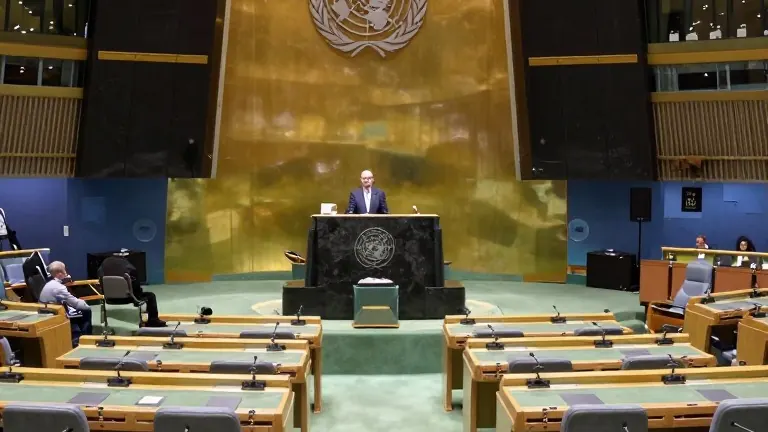
U.S. Ambassador Mike Waltz urged the United Nations General Assembly to reject a new resolution on Cuba during a briefing in New York on October 28, 2026.
Waltz framed the upcoming vote as the final barrier preventing the Cuban government from securing another propaganda victory. He argued that the assembly's decision would signal whether the international community acknowledged the island's internal economic failures or accepted the government's narrative of external blame.
The dispute escalated over the previous two days. On October 27, Waltz posed three questions to Cuban officials regarding the disparity between the leadership's wealth and the public's poverty. He noted that Cuban leaders owned luxury watches, yachts, and private islands while hospitals lacked medicine. During the subsequent exchange, Cuban diplomats allegedly struck desks and interrupted proceedings. One Cuban diplomat physically confronted a U.S. representative, a move Waltz said violated the host country agreement. That diplomat was scheduled to board a flight back to Havana on October 28.
During his October 28 explanation, Waltz highlighted specific trade data to counter the claim that a U.S. blockade exists. He stated that American companies exported $876 million in goods to Cuba in the first eight months of 2026. That total included $250 million in fuel, making the U.S. the largest supplier to the Cuban private sector. He listed shipments arriving from Belize, Canada, Chile, China, Colombia, Mexico, Russia, Spain, Uruguay, and the European Union to demonstrate open ports.
Waltz also referenced an investigation by the Miami Herald into GAESA, the military conglomerate controlling the Cuban economy. The report identified $18 billion in military-controlled assets and $14 billion in cash. Waltz noted that Cuba's former comptroller general admitted she could not audit GAESA before disappearing from public view two months later. He calculated that the cash on hand could pay all Cuban salaries for two years, stock pharmacies for 40 years, or buy 2 billion gallons of gasoline.
The ambassador pointed out that the regime currently holds 800 political prisoners. He invited assembly members to speak with José Daniel Ferrer and Orlando Gutiérrez-Boronat, both of whom attended the session. Ferrer had been imprisoned twice for demanding basic freedoms, while Gutiérrez-Boronat faced decades of persecution. Waltz said the regime uses the annual vote to tell the Cuban public that the world stands with the government, not the people.
President Trump committed an additional $100 million in food aid and medicine, routed through the Catholic Church to ensure distribution. Waltz thanked the Vatican for its humanitarian partnership. He argued that the Cuban government opposes this aid because it bypasses military monopolies that enrich the elite. The U.S. delegation asked members to vote no on the resolution to align with the Cuban people rather than the regime.
Source: Latin Opinion